Tuesday, June 07, 2011

Dell says, “Hola Los Angeles!”

Windows Experience Blog - Dell, en EspaƱol

“This morning Dell announced the new the new Inspiron M5030, the first Spanish-language laptop available in the U.S., to Los Angeles consumers. It’s the same laptop that Dell successfully introduced to customers in Miami and Atlanta in April. The M5030 is a really cool concept; it’s a great 15” laptop packed with an AMD Athlon™ II Dual-Core P360, 4GB of RAM, a huge 320GB hard drive, discrete ATI HD graphics, and an HD screen, and it’s outfitted with a Spanish-language keyboard and a Spanish version of Windows 7 Home Premium. And LA customers can get it for a very reasonable $499.

…”

A mouse in every hand, a notebook on every lap…

This isn’t something I’d take advantage of, but I think it’s kind of cool and since I’m a native Angeleno… :)

DevExpress gives 7 for 7 - 7 Webinars for Windows Phone 7

DevExpress - Free Windows Phone 7 Development Webinars

“Watch - Learn - Apply: Master Windows Phone 7 Application Development

DevExpress.com is proud to announce a free seven part webinar series on Windows Phone 7 development. Presented by Chris Williams - XNA MVP - these webinars explore the Windows Phone 7 platform in detail and offer practical insights into the mobile development options offered by Microsoft. WP7 webinar topics include:

Date Title
09-Jun-2011 An Introduction to WP7 Development with Silverlight and XNA
16-Jun-2011 A Deeper Dive Into XNA on Windows Phone 7
23-Jun-2011 A Deeper Dive Into Silverlight on Windows Phone 7
30-Jun-2011 Building a Scrolling Tile Engine with XNA on Windows Phone 7
07-Jul-2011 Building a pathfinding system using waypoints with XNA on WP7
14-Jul-2011 Using the Push Notifications Service in your Windows Phone 7 apps or games
21-Jul-2011 Making Money From Free Windows Phone 7 Apps with the Microsoft Ad SDK

…”

Got to love free training… :)

Sure it’s a means for DevExpress to increase the visibility in their other DevExpress product focused Webinars, but hey, what do you want for free, your money back? It’s a low key and non-intrusive approach, so no blood, no foul.

Monday, June 06, 2011

Oh please, don't let the trainers at work see this... Microsoft Research releases Biometrics (i.e. Fingerprint) Attendance Terminal (with source)

The Road to Know Where - Microsoft Research Releases Free Biometrics (Fingerprint) Attendance System

"Microsoft’s Biometrics Attendance Terminal offers a terminal for tracking the time and attendance of individuals, based on a biometric fingerprint. ..."

Man if they are taking fingerprints on the way in and out... that's like a mandatory work training nightmare! LOL But it would sure bet having to scratch our names and info and crud on all those sign in forms that go no where.

Best of all, there's source! A client and server portion, all with the code....

image

Black or White, circle or no, 130 free Metro icons

Metro Icons Pack

metro icon pack

130 Free to use and modify Metro Icons...

image

Related Past Post XRef:
A couple of my favorite things... Paint.Net and Windows Phone 7 (and using the one to create App and Tile icons for the other)
Sometimes a picture says… Photoshop Design Templates (and other design resources) for Windows Phone 7
Application Bar Icons for your Windows Phone 7 development
A Windows Phone 7 Development/Design Guidelines/Certification Requirements Cheat sheet/Checklist
The Noun Project, XAML’ified… or The Noun Project converted for you to XAML and PNG’s
“The Noun Project” + SVG + Free + Metro like look and feel + 500 = Happy Windows Phone 7 Developers

[Humor] The real “Cloud” revealed by xkcd

‘nuff said…

Visual Studio Mag Highlights 17 Free Visual Studio Tools

Visual Studio Mag - 17 Free Tools for Visual Studio

“What developer doesn't love a new toy? Especially if it's free and actually solves a problem that you face every day. Tools, however, are a very personal thing -- just because something works for someone else doesn't mean it will fit your style of development. You need a variety to pick from to find one worth keeping.

This is why I sifted through dozens of tools and utilities to come up with a list of free tools that can help .NET developers do their jobs better. I looked at both standalone tools -- which can be of value no matter what version of Visual Studio you use -- and Visual Studio add-ins, which integrate directly into the IDE UI.

I have a lot of respect for the people who created these .NET tools and Visual Studio add-ins (and the many others that didn't fit in this article). Many of these tools have been created by individual developers who have not only built the products, but have been actively supporting them for years and through several versions of the Microsoft .NET Framework. They're heroes. You should try out what they've created for you.

Standalone Tools
With two exceptions the tools in this section run independently of Visual Studio. Some of them (Regulator, for instance) have been around since the .NET Framework 1.0 and Visual Studio .NET, yet some developers don't seem to know about them. Others, like LINQPad, have appeared more recently to support new .NET technologies.

Visual Studio Add-Ins
Unlike the previous tools, add-ins integrate into the Visual Studio UI and respond to Visual Studio events. Microsoft has incorporated a gallery of add-ins into Visual Studio 2010 through the Extension Manager on the Tools menu. If you're a Visual Studio 2008 developer, you can find the Visual Studio Gallery tools at http://bit.ly/dxCqnl . While it's worth browsing through that list to see what interests you, it's very long. Here are some of the best tools from the Gallery, plus a few add-ins that can't be found in the Microsoft listing.

…”

These are some of the top tier, must have, Visual Studio tools/extensions. Many I’ve blogged about before, or I’m sure you’ve heard of before (who hasn’t heard of LINQPad? ), some that might be new to you…

Sunday, June 05, 2011

How can I find music/audio files on my system that are possible duplicates, say via audio finger printing, that also provides the C# source on how its done? This CodeProject project is how...

CodeProject - Duplicate songs detector via audio fingerprinting

screen2

...

As a software engineer, I was always interested in how a computer can be taught to behave intelligently, at least on some simple tasks that we (homo-sapiens) can easily solve within frames of seconds. One of them applies to audio recognition, which in recent years has been analyzed thoroughly. For this reason, in this article you will be introduced to one of complex tasks which arise in the field of computer science: the efficient comparison and recognition of analog signals in digital format. ...

...

In simple terms, if you want to compare audio files by their perceptual equality, you should create the so called "fingerprints" (similar to human fingerprints, which uniquely describe person's identity), and see if sets of these objects, gathered from different audio, match or not. Logically, similar audio objects should generate similar fingerprints, whereas different files should emanate unlike signatures. One of the requirements for these fingerprints is that they should act as "forgiving hashes", in order to cope with format differences, noise, "loudness", etc. The simplified concept of audio fingerprinting can be visualized below.

conceptialoverview

Basically, audio fingerprinting algorithms provide the ability to link short, unlabeled snippets of audio content to corresponding data about that content (it's all about finding unique characteristics of a song that can be later used to recall an unknown sample, or find a duplicate in the database of already processed songs). These types of algorithms can be used in a variety of different applications (please note, until Content Fingerprinting Using Wavelets was published, a number of other approaches have been developed):

  • Automatic population the metadata of a song (MusicBrainz)
  • Identifying a currently playing song (Shazam)
  • Monitoring radio broadcasts (Mediaguide, Nielson BSD)
  • Solving Peer-2-Peer copyright issues
  • Managing sound effect libraries
With all the advantages that the sound fingerprinting system has, there are several challenges that it has to address. One of them is a huge database to search (imagine Youtube's database of video content that is monitored for audio copyright issues). Normally, each song will generate a big amount of fingerprints (in the described algorithm the granularity of each of them is going to be 1.48 sec, so we'll have about 150 objects for 1 song). In conclusion, there will be a need in using an efficient search algorithm that works well, when the solution is scaled. The simplest approach is performing a simple comparison between the query point and each object in the database. But, because this method is too time-consuming, the k-nearest neighbor solution (Min-Hash + Locality Sensitive Hashing) will be explored.

..."

Audio Finger printing is currently all the rage with the different cloud music services coming online, etc. But just how is that done? This article/project provides one look into that. Also I don't think I've seen an audio finger printing solution made available this way (i.e. source available). And the fact the author mixes in some MVVM too is icing on the cake.

While I don't like to do this much, expect to see this project covered in a little more details on a future Coding4Fun blog post (it's just that I do those a week in advance and I thought this too cool not mention right now... and it's cool enough to get two posts anyway... lol  ;)

Saturday, June 04, 2011

4,000 science titles from the National Academies Press (NAP) now available as free PDF's (really, legally, direct from NAP, but registration is required...)

The National Academies Press Makes All PDF Books Free to Download; More Than 4,000 Titles Now Available Free to All Readers

"WASHINGTON -- As of today all PDF versions of books published by the National Academies Press will be downloadable to anyone free of charge. This includes a current catalog of more than 4,000 books plus future reports produced by the Press. The mission of the National Academies Press (NAP) -- publisher for the National Academy of Sciences, National Academy of Engineering, Institute of Medicine, and National Research Council -- is to disseminate the institutions' content as widely as possible while maintaining financial sustainability. ..."

National Academies Press (http://www.nap.edu/)

SNAGHTML7df9e91c
image

SNAGHTML7e006953

4,000 titles... That's going to take a bit to read... :P

(via Slashdot - National Academies Release Over 4,000 Free Science Books)

"Data Quality and Master Data Management with Microsoft SQL Server 2008 R2" Free 226 page eBook

SolidQ - Dejan Sarka & Davide Mauri: Data Quality and Master Data Management with Microsoft SQL Server 2008 R2

"...

This book deals with master data. It explains how we can recognize our master data. It stresses the importance of a good data model for data integrity. It shows how we can find areas of bad or suspicious data. It shows how we can proactively enforce better data quality and make an authoritative master data source through a specialized Master Data Management application. It also shows how we can tackle the problems with duplicate master data and the problems with identity mapping from different databases in order to create a unique representation of the master data.

For all the tasks mentioned in this book, we use the tools that are available in the Microsoft SQL Server 2008 R2 suite. In order to achieve our goal—good quality of our data—nearly any part of the suite turns to be useful. This is not a beginner’s book. We, the authors, suppose that you, the readers, have quite good knowledge of SQL Server Database Engine, .NET, and other tools from the SQL Server suite.

Achieving good quality of your master data is not an easy task. We hope this book will help you with this task and serve you as a guide for practical work and as a reference manual whenever you have problems with master data. ..."

image

I'm sorry to say I don't really know jack about MDM. Sure I've heard about it, and believe I know its basic premise, but beyond that it's a blank for me. So when I saw this book I knew I had to grab it. Now all I have to do is actually read it... :P

(via The Bit Bucket (Greg Low): IDisposable - Free SolidQ eBook - Data Quality and Master Data Management with SQL Server 2008 R2)

Windows Phone Game Bootcamp (Free, on-demand version)

Worldwide Events HomeWindows Phone Gaming Bootcamp

What is it?

This App and Gaming Bootcamp is an 8 hour event where you’ll learn about Windows Phone, learn how to build applications and learn how to build games. We’ll cover everything from location awareness (the GPS) through graphics design and animation; we’ll even cover topics like physics and cloud services.

This event will offer a mix of presentations, demos, labs and interactive sessions where you can follow along with the instructor. At the end of the day you’ll have a working basketball game, and we’ll even help first 50 people who are serious about selling in the marketplace get started for free (a $99 value). Even if you’re not ready to get started right away, we’ll show you how to kick off a new mobile business with free ultimate versions of almost all Microsoft products for the next three years.

What do I need?

If you’d simply like to watch the presentations and demos all you really need is Live Meeting. If you’d like to participate in the interactive sessions or complete any of the labs you’ll also need the following:

Important Note: If you plan to participate in the interactive sessions we recommended you join the meeting from a dual screen machine or join the meeting on a separate computer from where your dev tools are installed.

..."

image

3:12 hours of WP7 gaming dev goodness, on-demand.

(via Windows Phone Geek - FREE Window Phone Gaming Bootcamp Online)

Friday, June 03, 2011

A couple of my favorite things... Paint.Net and Windows Phone 7 (and using the one to create App and Tile icons for the other)

Windows Phone Geek - Creating WP7 Tile and Application Icons for FREE with Paint.NET

"In this post I am going to talk about how to make a Windows Phone 7 Tile Icon using Paint.NET: a FREE image and photo editor.

What is Paint.NET?

Paint.NET is free image and photo editing software for Windows. It has all the features that you will need when designing Icons,Images, etc. Some of the cool supported features are:

  • All standard Image editing features
  • Layers
  • Special Effects
  • Powerful Tools for drawing
  • Unlimited History

NOTE: Paint.NET is a free tool released under Creative Commons license. So you are free to build whatever icons/images you prefer and use them in your WP7 apps!

Building WP7 Tile Icon using Paint.NET

To begin with lets first mention some of the certification requirements related to Tile and Application icons:

Application icon should be:

  • PNG file format
  • 62 x 62 pixels

Tile icon should be:

  • PNG file format
  • 173x 173pixels

For more information take a look at our previous article: WP7 Application Icon and Application Tile Icon

First download and install Paint.NET from its official web site: http://www.getpaint.net/ .After successfully installing the tool just start it:

...

image"

This is my kind of tutorial (since I pretty worthless when it comes to "graphic tool usage"... lol). Simple, easy to follow and uses the uber Paint.Net!  :)


Related Past Post XRef:
Sometimes a picture says… Photoshop Design Templates (and other design resources) for Windows Phone 7
Application Bar Icons for your Windows Phone 7 development
A Windows Phone 7 Development/Design Guidelines/Certification Requirements Cheat sheet/Checklist
The Noun Project, XAML’ified… or The Noun Project converted for you to XAML and PNG’s
“The Noun Project” + SVG + Free + Metro like look and feel + 500 = Happy Windows Phone 7 Developers

How to Grow your Mango (knowledge that is) - Mango Training Course

DevFish on MSDN ...>««(o>... - WTH is the Windows Phone Mango Training Kit?

"One of my locals was having a tough time locating the Windows Phone "Mango" Training Kit . Search http://downloads.microsoft.com for mango, and nothing is there. So I thought I'd supply some the direct links. I also threw in a few of my other favorite "mango points of entry" as well.

Note I keep most of this stuff aggregated in the mango section of my screwturn wiki at http://dfwiki.devfish.net/technology.Windows-Phone-7-1-Mango-General.ashx?HL=mango .

Windows Phone "mango" Training Kit - compass, gyro, motion sensor, multi-tasking, fast app switching, background agents, alerts, reminders, live tiles, search extras, calendar and contact apis - http://msdn.microsoft.com/en-us/WP7MangoTrainingCourse

..."

Microsoft Developer Network - Learn - Courses - Windows Phone codenamed "Mango" Training Course

"Version: 1.0.0

The next version of Windows Phone (codenamed “Mango”) will ship later this year. Mango offers a lot of new capabilities for developers to create even better, more immersive user experiences on Windows Phone. This course will give you hands-on experience with important developer features in Mango.

After completing this course, you will be able to:

  • Get more out of the hardware with new APIs for compass, gyro, camera and a virtual motion sensor
  • Take advantage of the new multi-tasking capabilities such as fast app switching, background agents, alerts and reminders
  • Improve integration with the phone by using live tiles, Bing search extras, Bing maps, and the new calendar and contacts APIs

Happy Windows Phone coding! ..."

Once installed, here's the start page for the Lab;

image

Each lab is what you'd expect, a starting point and then written lab instructions walking you through each learning step.

It's only a 65MB download... If want to Mango, then you'll want to get this.

Skinning your Windows Phone 7 Screenshots...

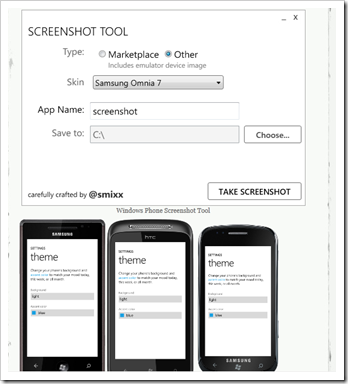
Cory Smith (@smixx) - Windows Phone Screenshot tool with skins!

"I’ve been working away slowly at these changes for a while now but its time for me to set them free on the Windows Phone community!

Updates:

  • Clickonce installer for easier updates
  • Now supports landscape mode!
  • Support for multiple monitors
  • Improved error handling
  • Fixed bug where app name was not used in the screenshot filename
  • Ensures Marketplace screenshot is Portrait and at 100% zoom level
  • Now includes the following skins!
    • Default Emulator
    • HTC HD7 (Added June 1st, 2011, requested by @MGL74)
    • HTC Mozart (thanks to Danijel Malik)
    • LG Optimus 7
    • Samsung Focus (thanks to Jeff Wilcox)
    • Samsung Omnia 7 (special request from @sstranger

...

image..."

I dig the skinning support. Really gives the screenshots a nice extra touch...


Related Past Post XRef:
Make capturing Windows Phone 7 Marketplace app submission screenshots simple and easy with the "WP7 Simulator Cropper

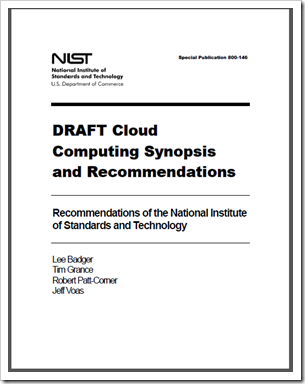
Never a Cloudy day in DC? Not if the NIST has anything to say about it... "DRAFT Cloud Computing Synopsis and Recommendations"

Catalyst - NIST Issues Draft Recommendations on Cloud Computing

"Earlier this month, the Computer Security Division of the National Institute of Standards and Technology (NIST) issued draft recommendations on cloud computing (PDF). As many of you know, NIST is an agency of the U.S. Department of Commerce. Founded in 1901, the agency was the nation’s first physical science research laboratory.

...

What is Cloud Computing?

In the 84-page draft, Cloud Computing Synopsis and Recommendations, published May 12, the NIST team set out to write a primer on the cloud—types, deployment models, service models, cloud security and, ultimately, the benefits of cloud computing. They start with NIST’s definition of cloud computing, which is tricky because:

Cloud computing is not a single kind of system, but instead spans a spectrum of underlying technologies, configuration possibilities, service models, and deployment models.

Thus, while the term “cloud” is often used as a synonym for the Internet, cloud computing means more than simply the transmission of data over the Internet.

....

Why Read the Guidelines

If you are considering the cloud for any of your applications, this is a helpful document. The authors discuss operational characteristics, standards for service-level agreements and security considerations. Ultimately, they talk about the benefits of cloud computing and why organizations like law firms and corporations businesses might consider it.

..."

National Institute of Standards and Technology - Cloud Computing Synopsis and Recommendations
imageimage

Executive Summary

Cloud computing allows computer users to conveniently rent access to fully featured applications, to software development and deployment environments, and to computing infrastructure assets such as network-accessible data storage and processing.

This document reviews the NIST-established definition of cloud computing, describes cloud computing benefits and open issues, presents an overview of major classes of cloud technology, and provides guidelines and recommendations on how organizations should consider the relative opportunities and risks of cloud computing. Cloud computing has been the subject of a great deal of commentary. Attempts to describe cloud computing in general terms, however, have been problematic because cloud computing is not a single kind of system, but instead spans a spectrum of underlying technologies, configuration possibilities, service models, and deployment models. This document describes cloud systems and discusses their strengths and weaknesses.

Depending on an organization's requirements, different technologies and configurations are appropriate. To understand which part of the spectrum of cloud systems is most appropriate for a given need, an organization should consider how clouds can be deployed (deployment models), what kinds of services can be provided to customers (service models), the economic opportunities and risks of using cloud services (economic considerations), the technical characteristics of cloud services such as performance and reliability (operational characteristics), typical terms of service (service level agreements), and the security opportunities and risks (security).

Deployment Models. A cloud computing system may be deployed privately or hosted on the premises of a cloud customer, may be shared among a limited number of trusted partners, may be hosted by a third party, or may be a publically accessible service, i.e., a public cloud. Depending on the kind of cloud deployment, the cloud may have limited private computing resources, or may have access to large quantities of remotely accessed resources. The different deployment models present a number of tradeoffs in how customers can control their resources, and the scale, cost, and availability of resources.

Service Models. A cloud can provide access to software applications such as email or office productivity tools (the Software as a Service, or SaaS, service model), or can provide a toolkit for customers to use to build and operate their own software (the Platform as a Service, or PaaS, service model), or can provide network access to traditional computing resources such as processing power and storage (the Infrastructure as a Service, or IaaS, service model). The different service models have different strengths and are suitable for different customers and business objectives. Generally, interoperability and portability of customer workloads is more achievable in the IaaS service model because the building blocks of IaaS offerings are relatively well-defined, e.g., network protocols, CPU instruction sets, legacy
device interfaces.

Economic Considerations. In outsourced and public deployment models, cloud computing provides convenient rental of computing resources: users pay service charges while using a service but need not pay large up-front acquisition costs to build a computing infrastructure. The reduction of up-front costs reduces the risks for pilot projects and experimental efforts, thus reducing a barrier to organizational flexibility, or agility. In outsourced and public deployment models, cloud computing also can provide elasticity, that is, the ability for customers to quickly request, receive, and later release as many resources as needed. By using an elastic cloud, customers may be able to avoid excessive costs from overprovisioning, i.e., building enough capacity for peak demand and then not using the capacity in non-peak periods. Whether or not cloud computing reduces overall costs for an organization depends on a careful analysis of all the costs of operation, compliance, and security, including costs to migrate to and, if necessary, migrate from a cloud.

Operational Characteristics. Cloud computing favors applications that can be broken up into small independent parts. Cloud systems generally depend on networking and hence any limitations on networking, such as data import/export bottlenecks or service disruptions, reduce cloud utility, especially for applications that are not tolerant of disruptions.

Service Level Agreements (SLAs). Organizations should understand the terms of the SLA, their responsibilities, and those of the service provider, before using a cloud service. Security. Organizations should be aware of the security issues that exist in cloud computing and of applicable NIST publications such as NIST Special Publication (SP) 800-53. As complex networked systems, clouds are affected by traditional computer and network security issues such as the needs to provide data confidentiality, data integrity, and system availability. By imposing uniform management practices, clouds may be able to improve on some security update and response issues. Clouds, however, also have potential to aggregate an unprecedented quantity and variety of customer data in cloud data centers. This potential vulnerability requires a high degree of confidence and transparency that cloud providers can keep customer data isolated and protected. Also, cloud users and administrators rely heavily on Web browsers, so browser security failures can lead to cloud security breaches. The privacy and security of cloud computing depend primarily on whether the cloud service provider has implemented robust security controls and a sound privacy policy desired by their customers, the visibility that customers have into its performance, and how well it is managed. Inherently, the move to cloud computing is a business decision in which the business case should consider the relevant factors some of which include readiness of existing applications for cloud deployment, transition costs and life-cycle costs, maturity of service

I know you all know what the "cloud" is, its different aspects, etc. So why am I still blogging about it? Because this guide from the NIST may be something we can use to explain it to others. To share with co-workers, superiors, senior management, etc. who may just now be thinking about "cloud" (and maybe thinking, "oh we run stuff on 'servers' and connect to them over the 'internet' so we're already 'cloud'..." sigh...)

And look, our tax dollars have already been spent on this draft, we might as well leverage where we can...

Thursday, June 02, 2011

SQL Server Version Number Database (SQL Server 6.5 through 2008 R2 SP1 CTP...)

SQL Security.com - SQL Server Version Database

"This is a database of SQL Server versions for those of us who want to know what possible vulnerabilities may exist in unpatched SQL Server systems. This makes it easier for those of us tasked with securing those environments to prepare the proper documentation outlining the threat. Special thanks to Ken Klaft for helping maintain this area of the site. With the seamingly endless stream of PSS-only releases out there this gets to be really time-consuming.

--Chip

SNAGHTML746ee5b0

image..."

This is as complete of a SQL Server version listing I've ever seen...

(Bite my bytes - Links of the week #151)


Related Past Post XRef:
"Select @@Version" is old school... Check out the ServerProperty function
SQL Server Version Numbers - That @@version number means my SQL Server is running what SP?